How to create a form in Yandex Forms
You can create a form in Yandex Forms and add it to a Yandex Tracker queue.
Publishing your form via a direct link or placing it on a website or Wiki page will allow other users to create issues from that form even if they don't have access to Yandex Tracker. Forms can be useful when you need to accept support or service requests from users, or in similar scenarios: Accepting requests by email and via forms.
You can also create a form in Yandex Tracker's form builder: Integration in the Yandex Tracker interface.
Step 1. Create and configure your form
-
Go to Yandex Forms. If the service is not activated, contact your company's administrator.
-
Create a new form.
-
Configure the form to collect the data required for creating an issue.
-
Set up integration with Yandex Tracker:
-
Specify the queue and other issue parameters.
-
Use the Issue description field to add answers to the questions included in your form.
-
To add an issue field that isn't available in the list of issue parameters, select Add issue parameter and start typing its name, then select the desired parameter from the suggested options.
-
If you want to save an answer to a certain form question in your issue parameters, select an issue field, click , then click Answer and select the question.
-
Save your integration settings.
For more information about the integration settings, see Yandex Forms Help
As a result, the form will send user answers to Tracker, and new issues will be created in Yandex Tracker.
-
-
Configure access rights to the form.
By default, all users can fill out the form. You can only allow users from your organization to fill out the form. -
Publish the form as described in Yandex Forms Help. Your form will be accessible via a link specified in the Link field.
Step 2. Connect your form to the queue
Managing the queue's forms requires the Queue management access rights.
You can add up to 20 forms to one queue.
-
Go to Tracker .
-
In the left-hand panel, click Queues and select a queue.
-
In the top right corner of the queue page, click Queue settings.
-
Go to the Integrations tab.
-
Under Forms, click Add form→ Link existing.
-
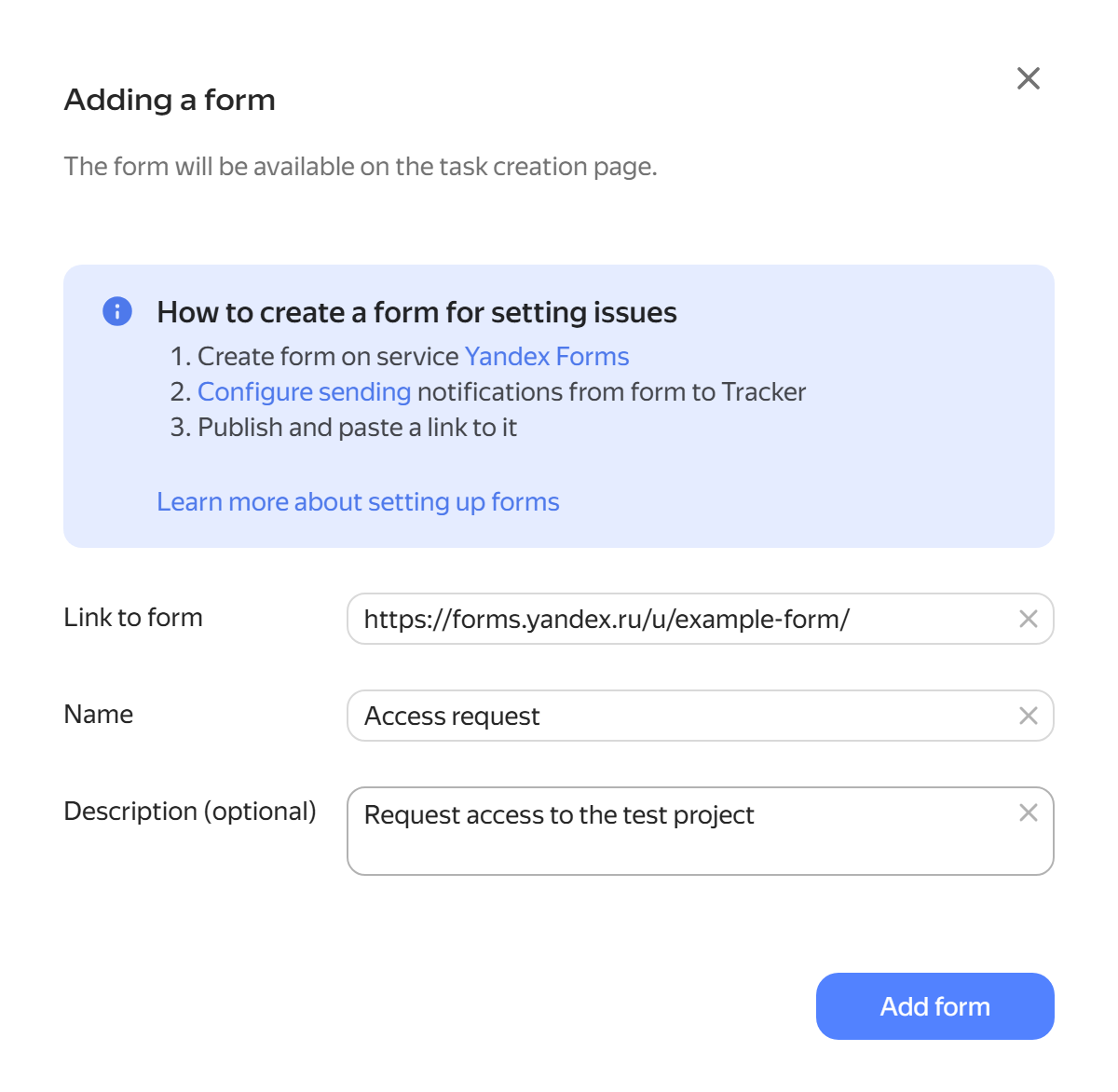
Add a link to the form.
-
Add a name and description for the form. Users will see them in the form selection window when creating an issue and in the list of forms linked to the queue.
-
Click Add form.
The form you created will appear on the issue creation page: How to create an issue in Tracker.
You can manage forms for creating issues on the queue settings page: Managing forms in a queue.
Learn more:
- How to set up Yandex Tracker integration with Yandex Forms
- Integration in the Yandex Tracker interface
- Managing forms in a queue
- Yandex Forms Help
A queue is a space for issues related to a single process, product, team, or department. A queue helps you store issues in one place and manage work according to common rules.