How do I set up a trigger?
A trigger is a set of actions on an issue that are executed automatically when certain conditions are met. For example, if the issue status changes or if a certain user subscribes to the issue, the trigger can change the issue's parameters, post a comment, or send an HTTP request.
You can use triggers to automatically assign issues or send notifications from Yandex Tracker to messaging apps.
Each queue has its own set of triggers. Triggers are applied one by one in the sequence listed in the queue settings. However, you can manually change the trigger order if necessary.
To set up triggers, the Queue management access rights are required.
Creating a new trigger
You can add up to 1000 triggers to one queue.
To create a new trigger for queue issues:
-
In the left-hand panel, click Queues and select a queue.
-
In the top right corner of the queue page, click Queue settings.
-
Select Automation in the left-hand panel.
-
In the top right corner, click Create → Trigger.
-
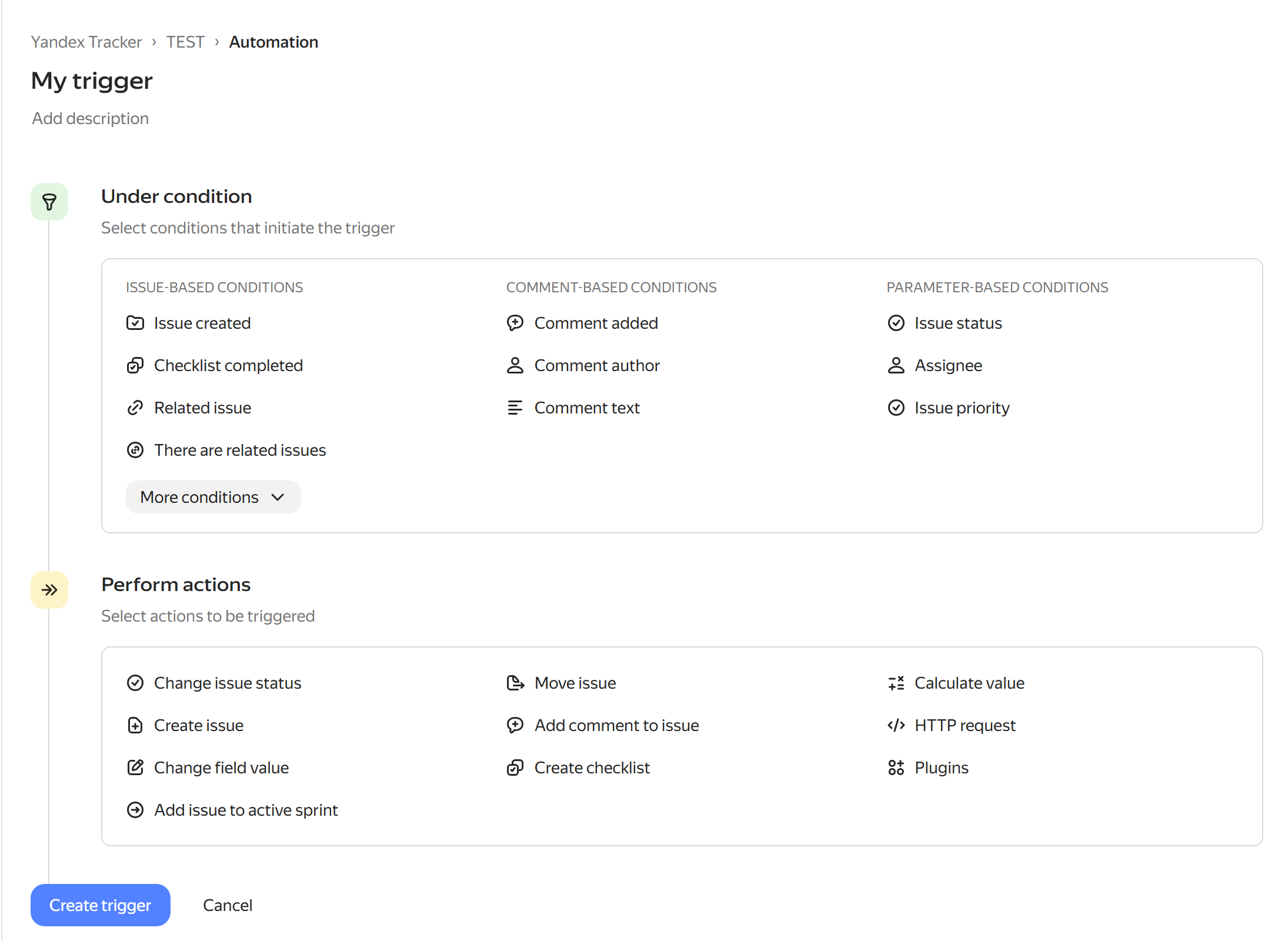
Enter a name for the trigger.
You can add a description below the name. -
In the Under condition section, specify issue updates that will fire the trigger.
-
Under Perform actions, select one or more actions on the issue.
-
Click Create.
The new automation will appear in the list in a few seconds after being added.
Creating a copy of a trigger
To copy a trigger:
-
Hover over the trigger in the list of automations and click → Duplicate.
-
Select where to copy the trigger: To current queue or To another queue.
Limitation
If local queue fields are used in the trigger settings, you can't copy the trigger to a different queue.
Changing the trigger priority
Sorting in the trigger list is set to Random order by default. In this mode, you can sort triggers by parameters such as Title, ID, or Modified. To do this, click the respective column name.
To change the order in which triggers fire:
-
In the Automation section, go to the Triggers tab.
-
At the top right of the trigger list, click Order of triggers. The triggers will be sorted in the order of execution.
-
Hover over the trigger, click , and drag the trigger to where you want it.
Viewing trigger history
To view the trigger execution and change history, in the list of automations click → History.
The Trigger history panel displays a list of events in chronological order. Each event shows the time and type:
-
Executed — the trigger fired in the issue. To view details, click the event row or . The details show the issue key and name. Click the issue key to go to the comment in the issue with information about the trigger execution.
-
Failed — the trigger fired in the issue, but one or more actions failed. To view details, click the event row or . The details always show the issue key. Click the issue key to go to the comment in the issue with information about the trigger execution. If the trigger has the Send HTTP request action configured, the request result is also displayed: execution status, address, and error message.
-
Trigger created or Trigger changed — the trigger was created or its settings were changed. Click the event row to go to the queue's Changelog and view details.
To find specific events, use the filters at the top of the panel:
-
Events — select one or more event types: Trigger creation, Trigger change, Action execution. Click Apply.
-
Period — specify a date range for displaying events.
Disabling a trigger
If you don't plan to use a trigger temporarily, don't delete it. Disable the trigger using one of the following methods:
-
In the list of automations, select the trigger and toggle the switch next to it.
-
In the trigger settings:
-
In the list of automations, click the name of the desired trigger.
-
On the trigger page, in the top right corner, toggle the switch.
-
Deleting a trigger
You can delete a trigger using one of the following methods:
-
In the list of automations, hover over the trigger and click Delete.
-
In the trigger settings:
-
In the list of automations, click the name of the desired trigger.
-
On the trigger page, in the top right corner, click → Delete.
-